As the final standings have been reaped in the group stages of Paris 2024, a win for Canada officially sees Australia out of the Olympic Games. After falling to another defeat at the hands of the USA, many questions are to be asked of Tony Gustavsson and his side.
As for the USA, the Emma Hayes era is off to a bang. Three consecutive victories and a spot in the quarter final stages, the next generation of the USA proves to be a shining light.
Does Tony Gustvasson have the answers?
With reports emerging that Gustavsson will part ways with the Matildas following their now-finished campaign at the Olympic Games, serious questions are being asked of his managerial style.
Embed from Getty ImagesWith the Australians reverting to a back five in order to combat the ever-pressing attack of the USA, Gustavsson opted for a more suitable style to fight against the dynamic American forward line. But did his pre-match tactic session solely involve him saying ‘Park the Bus!’, or was there any intended plan for his side in areas higher up the field?
With the armoury of attacking players that Australia have in their ranks, there really isn’t any room to brand yourself an underdog. Caitlin Foord and Mary Fowler are both Barclays Women’s Super League contenders at Arsenal and Manchester City, Hayley Raso has only recently departed Real Madrid, and Ellie Carpenter of Lyon combines with those aforementioned to catalyse play from the defensive lines. The talent is there, but it is being deserted.
Australia’s forward line has lacked tactical bite in the Olympics stint, and it seems to have occurred as a result of a lost playing list left without orders that equate to anything of substance. It is all well and good throwing your team into a back five, but when Trinity Rodman strikes with inevitability, the complacency shown in the other areas of the field is simply inexcusable.
Australia answerless in attack
As I have mentioned on several accounts over the previous two match days, Australia still looked to be lacking any real bite in the attacking third. Whilst Caitlin Foord and Hayley Raso remained almost anonymous, any possession gained by the Matildas midfield was almost immediately snapped up by the expectant Americans in defence.
After Michelle Heyman’s comeback performance against Zambia, the striker came off the bench once again to provide a silky assist for Alanna Kennedy’s last minute goal. Whilst remaining the only real Australian posing a threat in the attacking third, it begs the question- Why didn’t she start?
While Caitlin Foord battles through several consecutive calendar years of football without breaks, the Arsenal forward looks to be a classic case of on-field burn out. Her actual position seems to be circled with a question mark, as do all of the Matildas forwards in what has panned out to be a disjointed game plan.
As the Matildas now phase out of a golden generation, the job of the new manager is one of large difficulty. Clare Wheeler showed glimpses despite a disappointing error that lead to Albert’s goal, with the right game plan Australia should see Cooney-Cross and Fowler flourish with dominance, and Clare Hunt remained strong in moments despite the onslaught of forward pressure across the three fixtures. Though the talent at the top age could be close to irreplaceable, as Steph Catley, Caitlin Foord, Sam Kerr, Alanna Kennedy, Katrina Gorry (to only name a few) stare down the expiration of their international careers.
Engines up the wing
Emily Fox and Crystal Dunn worked the lines with expertise. Both players operated in both directions, catalysing the forward motions whilst also shutting down any glimpse of an Australian attack.
There will be many words said about the stars of the frontline in Sophia Smith and Trinity Rodman, but neither would have the freedom to excel without the discipline of Fox and Dunn in the fullback positions behind them.
Embed from Getty ImagesFox was mature and dynamic, knowing when to press her player and when to jockey back. The combinations made with her central teammates and those on the wing were well-calculated, and any sign of flame heating up in the Australian attack was quickly extinguished by the Arsenal defender.
Dunn played with a distinct maturity only present in players with her level of expertise, as she dictated the width whilst shutting down any alert of attack from the Aussies.
The pair were rested early in the encounter as the USA had already guaranteed their spot in the quarter final stages well before the kick off in Marseille, but both had made their distinct impact across the time spent on the field.
The Rodman Show
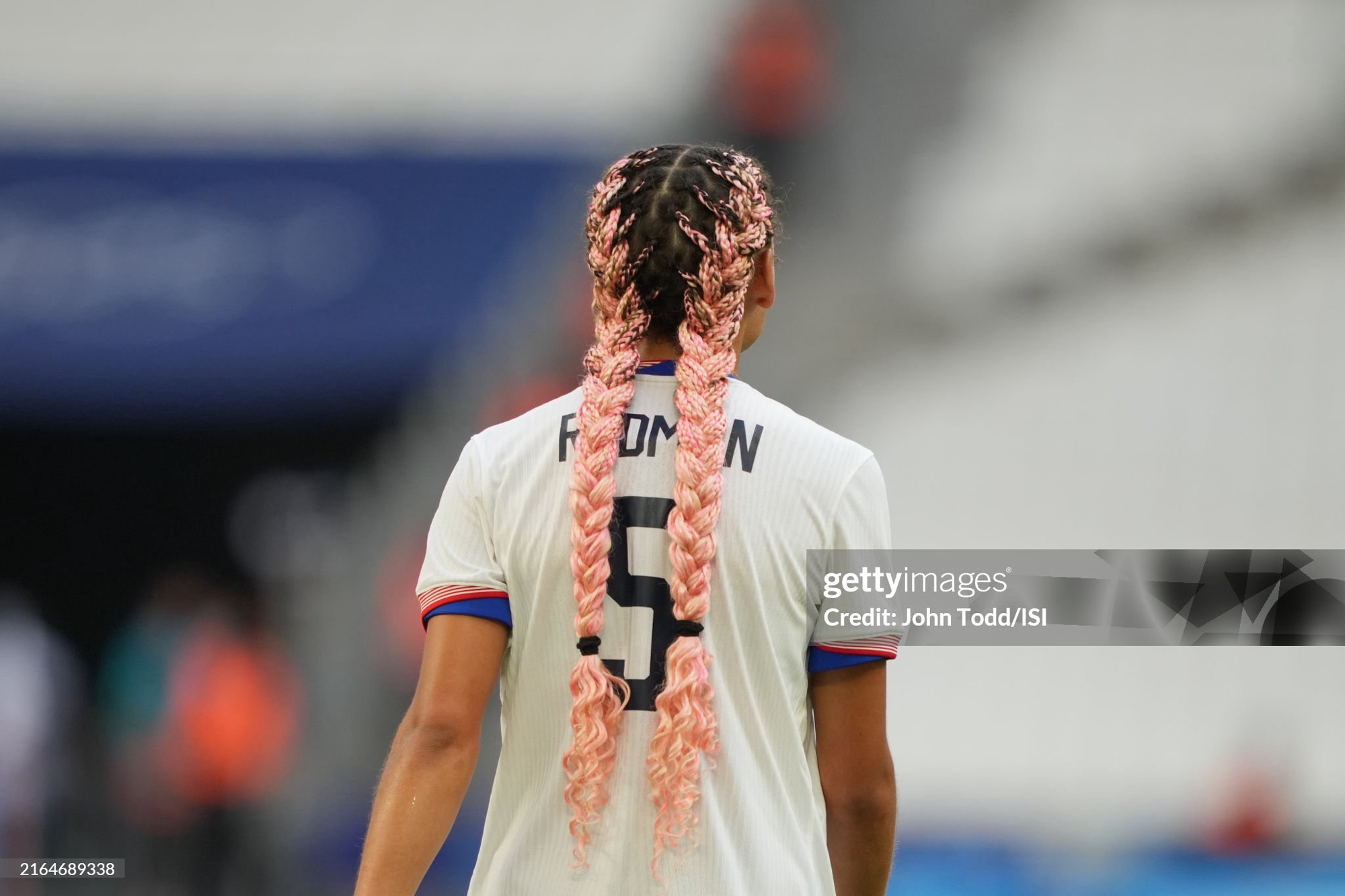
Embed from Getty ImagesHaving made an exceptional mark on all three group stage fixtures, Trinity Rodman continues to prove why she is the frontrunner for the next generation of the USWNT.
To eat my previous words ‘There will be many words said about the stars of the frontline’- Yes there will be, and here they are.
Not only did she write her name on the score sheet once again, Rodman proved ruthless along the entire length of the touchline. Working back with discipline to cover the attacking motions made by the Aussies, Rodman’s pure athleticism saw her dictate the wide territory brilliantly.
Her discipline is almost instinctive, as she refuses to sit down no matter if she is in or out of possession. Her ability to play on both feet had Torpey and Catley emulate two confused spinning tops, as she both cut-in and streamed down the wing with decisive intelligence.
Move over Dad, Trinity Rodman is now the shining star of the Rodman family.