
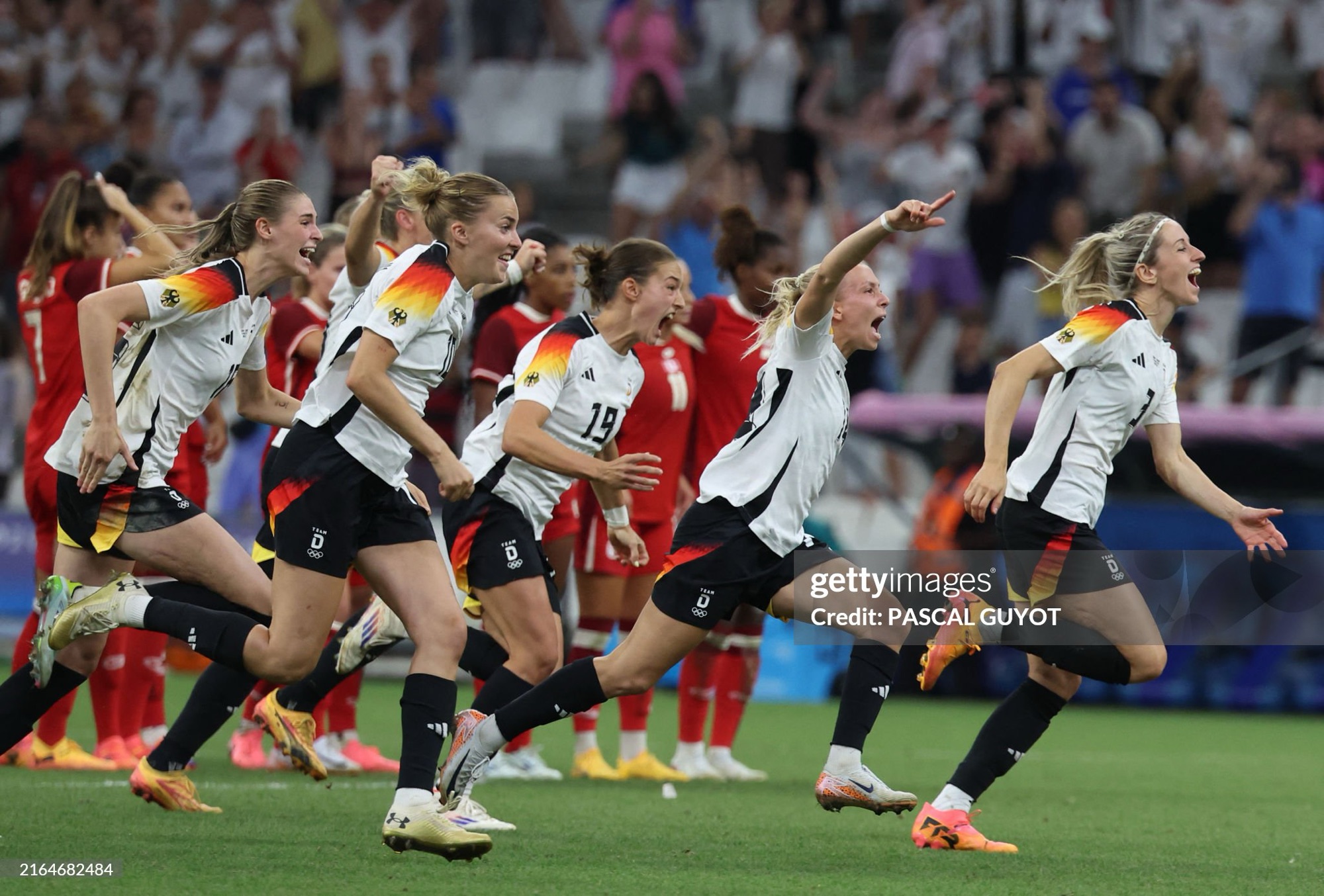
An experienced coach met a temporary one as Horst Hrubesch’s Germany side faced off with Andy Spence’s Canada as a place in the semi final against the USA hung in the balance.
The group stages saw similar points but different executions for both sides, as Germany won two of their fixtures, lost the other, all while scoring eight and conceding two. Canada gained maximum points, winning all three fixtures, scoring five and conceding two. All of that was in the past as the two sides met in the The Stade Vélodrome in Marseille with a place in the semi-finals at stake.
Embed from Getty ImagesTwo of the Best Defences face off
From the start of the match, it was clear to see that this was a match-up of the highest calibre of defences. Outside of Germany’s 4-1 freak loss to the USA, both sides had displayed some of the best defences we have seen in these Olympic games. Despite the respective nations having made defensive changes throughout the tournament, the quality never dipped, and it shone in Marseille.
From outset, Canada’s back three showed their strengths. The experience of Kadeisha Bunchanan and Vanessa Gilles was met with the youthful excellence of Jade Rose, as the three worked tightly and cohesively to keep the Germans out. With the added support of Chelsea’s Ashley Lawrence, and Washington Spirit’s Gabrielle Carle, the back line minimised the efforts of a tenacious German front line.
Likewise, Germany’s back four painted a similar picture. Whilst a cheeky nutmeg from Rose got the better of Felicitas Rauch, Germany were strong and precise as they both defended well against the Canadian pressure. The experienced duo of Marina Hegering and Kathrin Hendrich were especially excellent when Canada came forward, giving Guilia Gwinn the freedom to come forward as she likes.
The two standout defensive chess pieces came from the goalkeepers, with both Kaylan Sheridan and Ann-Katrin Berger flexing their strengths in the NWSL, the two shone in Marseille. With an answer to everything that was questioned of them, they encompassed the collective efforts of the defences and showed their experience and strength.
A Maple Game of Space
Canada’s exploitation of Germany’s self-made space was a high point of the fixture. Whilst Canada were compact and tight on the defence, Germany’s outspread back four meant Canada could use the small spaces in between to the best of their advantage. It is in these small spaces that Canada were able to create their best chances, and exploit Germany with the most success.
With both Rose and Lawrence exploiting the same area on the right, Canada built their attacks in the narrow areas. Similarly, space down the centre was used to break down a robust German defence. With a small-spaces technician such as Jessie Fleming playing in the attacking midfield position, it was a no brainer approach. Fleming excels at using the smallest of spaces to progress attacking sequences, and along with support from Quinn and Simi Awujo, Canada did just that.
Whilst Germany were all out speed and attack down the flanks, Canada used their strengths to create forward motions that were difficult for their opponents to stop. Though despite their advances, the lack of a clinical edge from the Canadians- as well as Berger’s dominance in goal- continued to hinder their chances of a goal. Though their game plan was showing great strength against the Europeans.
Embed from Getty ImagesGermany Fighting Demons
For all the well deserved praise of Canada’s defence, there must also be room for a conversation about Germany’s lack of finishing. For a team that had been excellent in front of goal in the group stages, Germany were lacklustre and unintentional in the box. It was a stark difference to the Germany that had been seen before.
Lea Schüller was the most shocking of the forwards. Whilst many chances were snuffed out by Gilles and Buchanan, she performed in a manner very unlike her usual self. Likewise, Klara Bühl and Jule Brand struggled against unshakeable defenders in Carle and Rose. Chances were a plenty, especially in the second half, but the answers were never met.
Likewise, Germany lacked their finishing qualities on dead ball situations. With seven corners and the height and talent to convert from them, Germany were without any response. The side registered six shots, but only one on target- a glaring indication that Germany seemed a ghost of their group stages selves.
No Fleming… No problem?
It is no secret Jessie Fleming is the heart and soul of this Canadian team. The team’s captain and engine is the first name on the team sheet and their most productive and effective player consistency. Having not missed a minute in the group stages, her half-time substitute against Germany posed a new challenge. How do Canada work without the hero from Tokyo?
A switch in play and changes to alert the side, Canada grew without her. Pushing Germany well, the likes of Adriana Leon and Janine Beckie compensated for Fleming’s missing powers. Changing to a front three, Canada looked stronger in her absence.
The biggest key was Cloé Lacasse. Whilst her introduction came for Huitema and not Fleming, the switch in formation helped Lacasse shine. She controlled the wing with precision, speed and control. Though as ever, Canada were colourless when searching to gain the advantage for their hard fought efforts. Registering 22 shots and five on target, Canada should have scored, though they lacked the courage, colour, and conciseness.
In a game won in penalties, and lost in the inability to score in regular game time, Germany thank Ann-Katrin Berger for her heroics in the penalty shootout. Saving two, and scoring the winner, the goalkeeper had the extra edge to see the reigning champions out of the competition. By the numbers, Canada should have won the quarter final meeting, but they continued to be their own worst enemy. Berger with the magic touch, and kick, her German side will meet ex-boss Emma Hayes and the USA in Lyon on Tuesday evening.