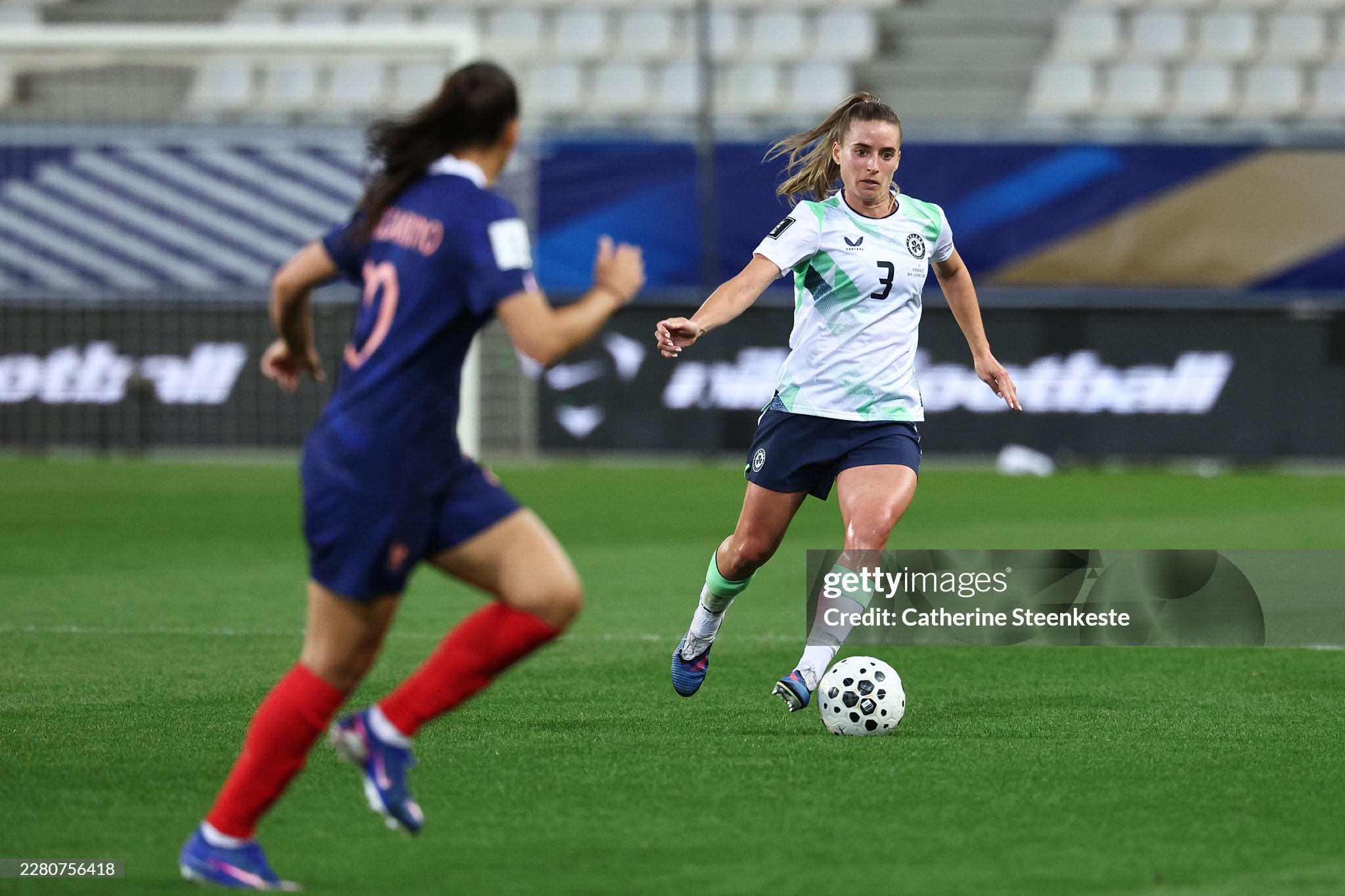

The USA stole the show at the death, as a clinical finish from Trinity Rodman saw the Americans scrape their way into the semi final stages of the 2024 Paris Olympic Games.
In what was a prolonged stalemate until the extra-time showing, here is what we analysed from the 1-0 fixture at Parc des Princes.
Well planned Japan
A dominant USA side have taken the Paris Olympics by storm, having scored 9 goals across 3 group stage matches in dynamic fashion. The newly-shaped American front line were causing nightmares for opponents, as Trinity Rodman, Sophia Smith, and Mallory Swanson asserted their dominance in France.
All signs pointed towards that form continuing as a quarter final meeting with Japan awaited them, but not all would commence accordingly for Emma Hayes as Japanese manager Futoshi Ikeda came prepared for the threat.
Embed from Getty ImagesThe Japanese defence looked disciplined in their set up, stifling any opportunity for the USA to crash through the gates of the attacking third. Moeka Minami did an exceptional job to nullify the threat of Trinity Rodman, whilst the Nadeshiko midfield stayed on top of the Americans.
The USA took 78 percent of possession into half time, but were unable to craft any of their time on the ball into something worthwhile due to the disciplined last line of Japan.
Japan strong defensively
As well as the structural discipline displayed by Futoshi Ikeda and his side in Paris, Japan asserted their dominance in 1v1 defending situations across the park. Allowing the Americans no room to breathe on the ball, Japan exercised the control over the majority of the ground duels to shut-out the USA front line with great effect. AS Roma teammates Moeka Minami and Saki Kumagai both worked in familiar cohesion to impose a physical threat on the ever-pressing American forwards.
As well as their defensive actions proving too strong for Emma Hayes’ side, Japan’s formidable pressure saw the USA frequently making unprecedented mistakes. Trinity Rodman saw herself given frequent chances to make a mark on the fixture’s early stages, though her failed first touches were probed by the formidabble Japanese defence right on her tail.
Midfield Amiss
When the USA found themselves ticking, Sophia Smith was able to insert herself into the game. Smith proved to be a threat in the width as the minutes ticked on, but often her craftsmanship was left unanswered in the box by an anonymous midfield group.
Rose Lavelle did well to coordinate the play from the deeper parts of the midfield third, but both Lindsey Horan and Korbin Albert struggled to make a true impact in the field of play. Too often were crosses by Smith left unanswered as Horan failed to present in the final third, meaning Japan were fast to clear any danger away.
Not only were well-crafted chances wasted by the lack of a forward-pressing midfield, the expectation of Horan to be there meant that Trinity Rodman refrained from timing her run inwards and toward the six-yard line, rather opting to create the wider option. Thus, the box was nearly always empty bar Swanson’s familiar run to the front post.
An injury to Tierna Davidson meant that Emily Sonnett started the fixture as a centre back, and with Sam Coffey missing the game due to suspension, the USA were without a player who could insert themselves into the starting lineup as a natural number 6. This meant that Korbin Albert opted to sit deep and static, struggling to find any cohesive rhythm with the players in front of her.
Horan and Albert, when deployed individually, are near-exact in their stylistic identity. Near-identical players being squeezed into a hole that does not fit raises immediate concerns regarding the midfield makeup of the USA roster, as Emma Hayes will be eagerly awaiting the return of Sam Coffey.
Hayes refrains from deploying her bench
Embed from Getty ImagesAs the USA struggled to gather any answers in the opening 90 minutes, the fans in red, white, and blue were anxiously awaiting any substitutions to be made from Emma Hayes. Though as the full-time whistle blew, Hayes opted for just the one change as Lynn Williams replaced Mallory Swanson for the additional thirty minutes of play. Under the assumption she was saving the fresh legs of her side for the impending possibility of a penalty shootout, Hayes ran the greater risk that those on the field would be out-ran by an explosive Japanese outfit.
A second change followed the aforementioned, as the USA manager chose to replace Rose Lavelle with Jenna Nighswonger for the final fifteen minutes of play. With a disjointed midfield in disarray, the decision to take off the game’s largest impacter in the central third was certainly a bold one.
Had Trinity Rodman not placed a top-shelf winner into the net to steal victory, it would be safe to say that American fans could rightfully point the fingers toward a severe underuse of a talented bench. Three games in six days and the side looked sluggish in moments- a state that could have played out to be a huge detriment if it weren’t for the Rodman heroics at the death. After 120 minutes and a game on Tuesday, Emma Hayes may be reconsidering her load management as she looks ahead to the semi finals of the Paris Olympic Games.