
Renée Slegers’ time at Arsenal as a player has all but been lost to history. Now, she has the opportunity to ensure her name will be remembered forever.
On January 24, 2007, the Arsenal Ladies hosted West Ham United in the first round of the London County Cup, or the London FA Women’s Cup as it was also known as. The outcome of this match would ordinarily have been a formality, this was after all, Arsenal in their absolute prime, having won every League and Cup game so far that season, and had already reached the UEFA Cup final. But for this tie, Arsenal’s English stars were unavailable, tied up with international commitments elsewhere.
In response, Vic Akers was forced to dip deep into his reserves to field a starting XI, and so, a mix of experience and academy stars took to the field at Potters Bar Town’s Lantern Stadium. Arsenal won 4-0, thanks to goals from Charlotte Gurr, Danielle Buet and a brace from Cori Daniels.

In Arsenal’s grand history, this match is of extreme insignificance, to such an extent that barely anything is even known about it. The sole evidence remaining that the game was played is a small match report in a matchday programme. However, there is one tiny detail from that match report that is worth noting. One word, bracketed.
Three months later, Arsenal were readying themselves for their first ever European Final. A trip to Umeå awaited as a part of their two-legged UEFA Cup Final, but before they could board their flight to Sweden, there was the small matter of a domestic Cup Final to win.
At Dagenham and Redbridge’s Victoria Ground, Arsenal defeated Millwall Lionesses 2-0 to win the London County Cup. Like their previous match against West Ham United, very little of this game is known, apart from the fact that Kelly Smith scored both goals. All that exists are a couple of matchday photographs, including one of the victorious team.

Slegers’ second chance to become an Arsenal star
This photo, and the earlier match report, are the only proof that remain of Renée Slegers’ time at Arsenal as a player. Like so many of the fringe players that season, her minutes were extremely limited, with just two appearances off the bench in the competition.
While the walls of the Emirates Stadium proudly display the household name heroes of that Invincible side, working together to hoist the European Cup aloft, many others have sadly had their efforts left discarded with the remnants of the past. Meghan McKeag, Liz Wicks, Danielle Bowman (née Buet), Sian Larkin, Félicienne Minnaar, Charlotte Gurr, Saulter, and of course, Slegers, all played in that final. Their efforts, along with the trophy itself, have sadly been lost in history.
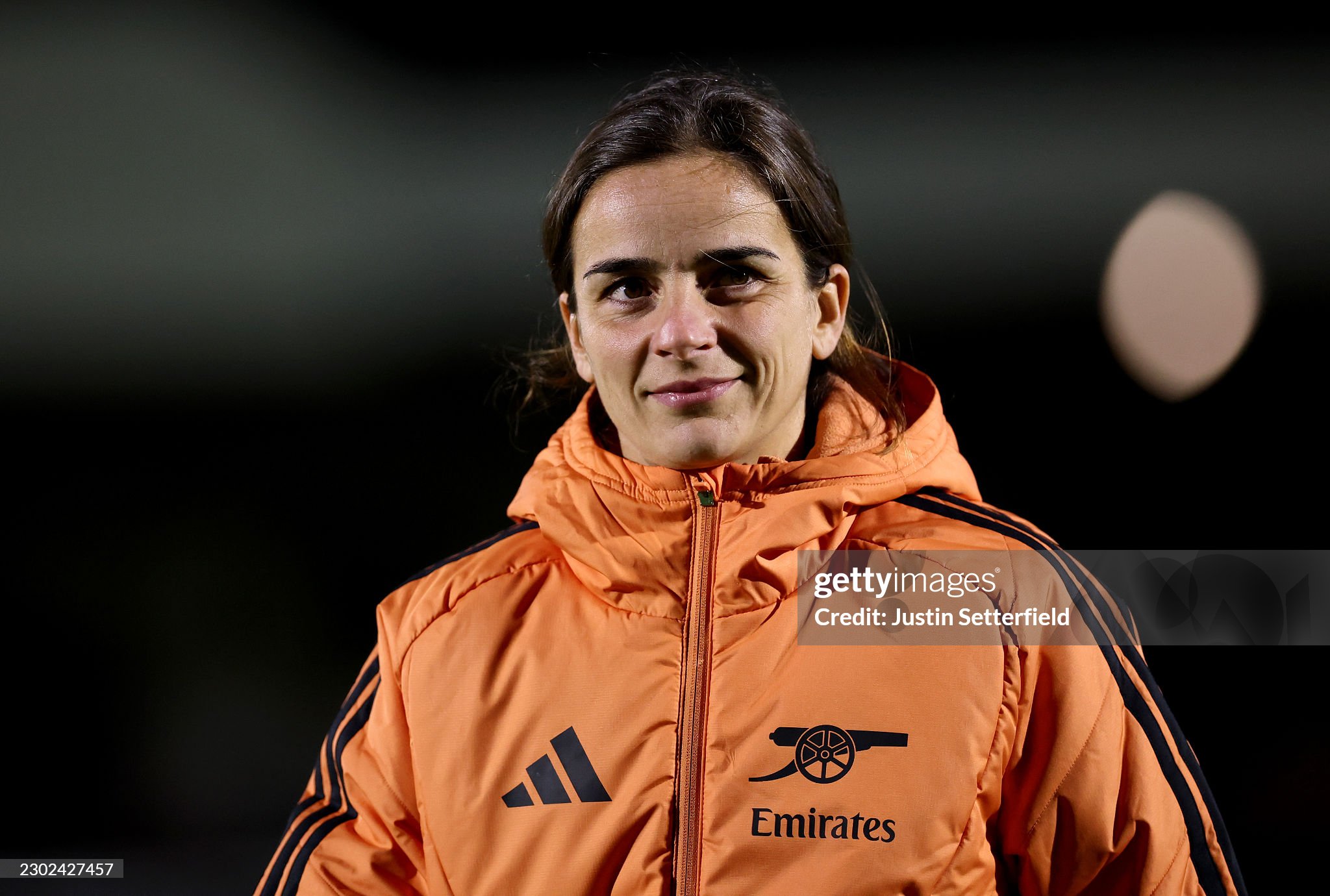
18 years later, and Slegers now finds herself back in North London. After months of interviews with the club, simultaneously getting Arsenal’s season back on track with an incredible run of form, she is the one who has been given the responsibility of taking the Gunners to the top once more, just as they were during her first spell at the club.
Her journey, there and back again, is well known. The serious knee injury forcing her to retire at the age of 29, her success in the Damallsvenskan as Rosengård manager, and now managing the club she briefly cameoed at during her youth. Her initial time in North London may have been brief, but unlike those she played with in that final, Slegers has been awarded a second chance to build a legacy that will stand the test of time.
Slegers’ head start has already paid dividends
Slegers’ selection is a divergent from the norm of recent managerial appointments. She is the first full-time female manager at the club since Shelley Kerr took the reins from 2013 to 2014. In the 10 years since, three men have been and gone, all securing just two trophies each during their time at the helm, and winning just one League title between all three of them.
By comparison, Arsenal’s most successful manager of the Barclays Women’s Super League (WSL) era, Laura Harvey, won five major trophies, including two League titles, plus further success pre-WSL. The interesting parallel with Harvey is that she, like Slegers, was previously part of the coaching set up, and only took up the role as manager in 2010 when Tony Gervaise departed mid-season.
Slegers is also in the unique position of having been a popular choice before even being given the job. Her predecessors all had to win over the players with their methods the moment they arrived. Slegers has already had a year at the club to acclimatise herself with the players as part of her role within the coaching team, and the benefits of this can be seen on the pitch.
Players have spoken of their joy of coming to work and playing under Slegers, something that was clearly absent prior to Jonas Eidevall’s resignation. There is a clarity and fluidity to their play, footballers now feeling comfortable expressing themselves, rather than the timid, withdrawn shell of a side chained to the structure that toiled to a 0-0 draw at home to Everton.
Just as important to win over the players, though, are the supporters. Whilst fans may have warmed to Eidevall as head coach when Arsenal were on the hunt for the title, and had won their first trophy for 4 years, they never seemed to bond with him as a person. That lack of a bond, despite his attempts to forge one, became more and more evident as the results deteriorated and the disgruntlement in the terraces spread.
By the end there were boos in the stands, graffiti on the walls, and a team without a manager. Slegers, meanwhile, was who the fans wanted. It was they who appeared to have convinced the then-interim head coach to go for the role, after witnessing their support for her at the end of their 1-1 draw with Manchester United at the Leigh Sports Village. Now, they have their wish.
Now, Slegers has to win
Fans, of course, can be fickle. Their faith in a manager can turn on a single result, and their backing of Slegers could just as easily dissolve if outcomes turn as they did for Eidevall. But Slegers’ results up until now have been good, with 12 wins in 13 matches in all competition helping to steer Arsenal back on course. What could have been argued as a new manager bounce looks to have the potential of something even stronger. It should be stressed, Slegers is not a novice coach for whom this is the first major break.
Despite being just 35, Slegers possesses plenty of winning experience, claiming two Damallsvenskan titles during her time at Rosengård after taking over following Eidevall’s departure there. With the Gunners, she has already exhibited plenty of tactical nous to suggest she is more than comfortable with managing at this higher level.
Decisions such as moving Steph Catley to left centre-back to solve some defensive issues (Arsenal have only conceded once in the WSL since Slegers took charge), or bringing Caitlin Foord off the bench against Crystal Palace to convert what was a narrow 1-0 lead into a comfortable 5-0 procession by full-time, have instilled confidence into the Arsenal faithful. However, bigger tests lie ahead, with away trips to Chelsea and Manchester City on the horizon guaranteed to provide the sternest of tests to Slegers’ managerial acumen.
Arsenal believe Slegers has the genuine potential to take the club back to where they once were, choosing her over bigger names and greater experience. For Slegers, her chance to become an Arsenal great has finally arrived, albeit 18 years later than she might have originally envisioned. First time around, Slegers got less than 90 minutes to express her talents. Now, she has 18 months to do just that, to bring WSL success back to Arsenal, and in doing so, leave a bigger impression on the club than a single word in a matchday programme.
Slegers has won over the club, the players, and the fans. Now, she has to win.