“We’re still so in our infancy in women’s football, in the grand scheme of things. So, it is going to take time,” said Ellen Rowles, PR and Communications Manager for Southampton FC.
Rowles is held in high regard by journalists for her impeccable organisational skills and approachable nature. We’re sitting down over Zoom after setting aside an hour to talk during the women’s international break, when her busy schedule lets up slightly. Rowles tells me she knew for a long time that she wanted to work in PR, and chose to study Media Communications and Culture at Bath Spa University.
Rowles grew up in a family of football fanatics. “It’s a dream job,” she says of her position with the Saints. “To my dad, no other sport exists. It’s only football, even to the extent that my parents go and watch England home and away, everywhere,” she laughs.
Rowles explains that although her job at Southampton was the first step in her football communications career, she now operates in a demanding, multifaceted role which spans across both the club’s men’s and women’s sides.
Women’s football is a part of the industry, and indeed a part of her job, that Rowles is particularly passionate about. However, this season has been a challenging one for Southampton, and for the Women’s Championship as a whole.
Once one of the highfliers of the English women’s football pyramid, Reading FC withdrew from the second tier at the end of last season in the wake of significant financial difficulties, leaving just 11 teams to compete for promotion to the Women’s Super League this campaign. Since then, Rowles says, “I think a massive scheduling issue has been the biggest thing we’ve noticed in terms of you could go a month without a game, potentially, and when you’re trying to build momentum to grow a fan base, it’s been tough.”
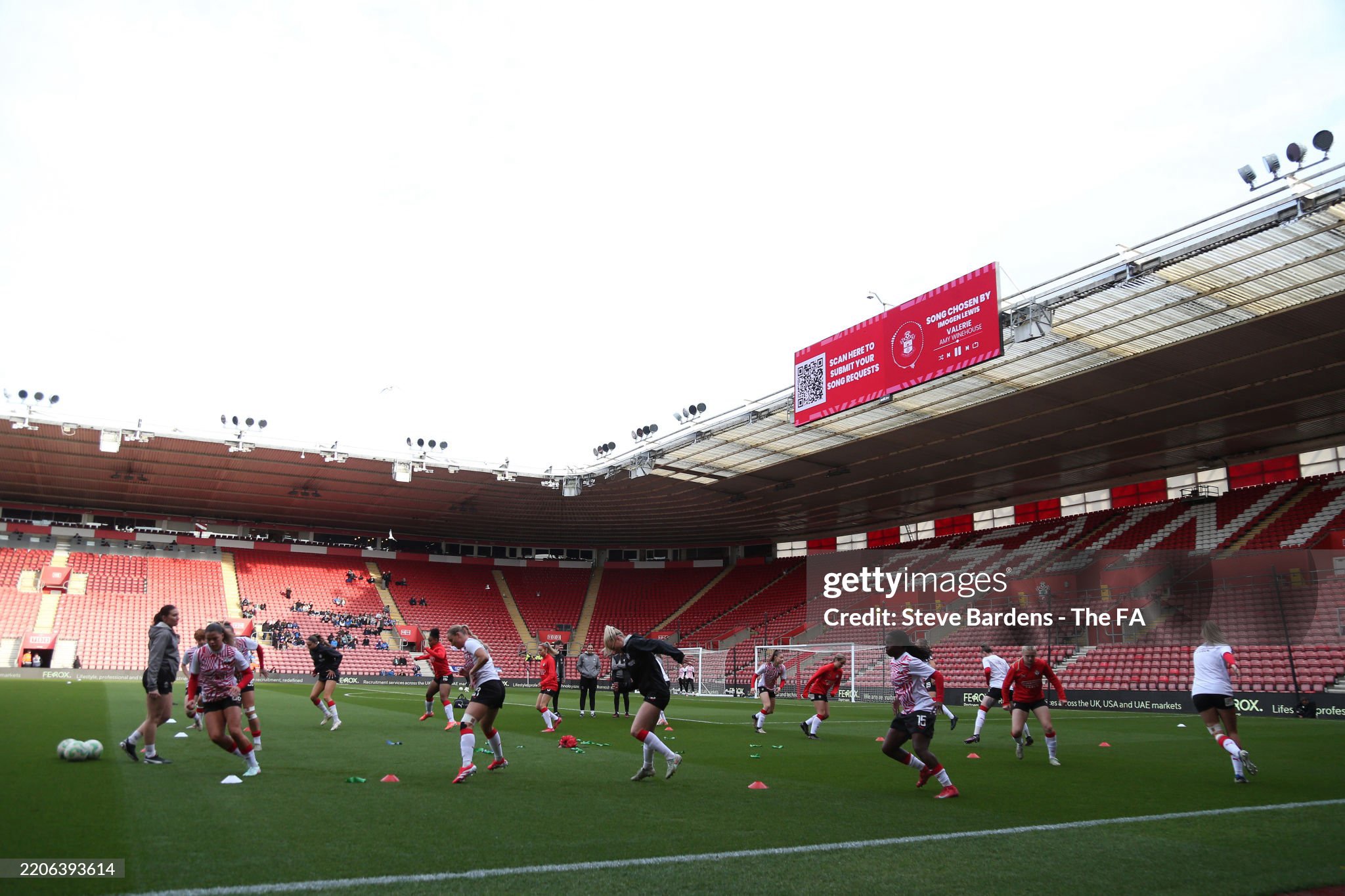
She continued: “At the start of the season, we had three home games in September in a row, but then we didn’t have another game at St Mary’s for a whole month. When you’re trying to build a fan base of getting people in the door, and they go a month without a game, it just it just kills it. It just kills any momentum that you’ve built. That’s been a huge thing we’ve felt and noticed is just the lack of games in the Championship in particular. It’s probably a bit different in the WSL, particularly where you’ve got Champions League and internationals, but in the Championship, there’s just not enough games.”
At the end of the 2021/22 season, Southampton won promotion from the FA Women’s National League South after beating Wolverhampton Wanderers in a closely fought playoff. The south coast club subsequently announced that they would adopt a fully professional model, and play all of their home games at St Mary’s Stadium.
Rowles started working for the club in January 2022, and provides me with an insight into what it’s like working in a league so often neglected by the media. “There definitely needs to be more coverage, I would say it is a lot more limited in terms of mainstream outlets.” Rowles details, “I’m sure every other Championship club would say the same thing. We’d just like more of it, more journalists coming to our games.”
Rowles has witnessed first-hand some of the most significant chapters in the Saints’ history thus far, and talks me through some of the trials and tribulations that come with working behind the scenes of women’s football through the unique lens of a communications manager. One of the primary concerns surrounding the women’s game in recent times has been the growing discrepancies between the clubs that thrive on consistent Premier League backing, and the clubs that don’t have the same resources available to them.
The Women’s Professional Leagues Limited recently suggested suspending relegation from the WSL in order to allow the gradual expansion of the topflight, but this blueprint comes with questions about whether some clubs may become complacent when it comes to investing in their women’s side if they know they are guaranteed to continue playing at the top level.
“We’re already seeing it, even in the Championship, you’re starting to see a gap between clubs,” Rowles explains, “I think with all the chat particularly at the moment, around like, how do we grow the league and how do we drive attendances? I don’t envy the job of the league, of the WPLL at the moment, because you look at it, and it is such a big task.”
With Southampton’s men’s side facing relegation from the Premier League, Rowles elaborated, “The teams that get promoted are just going straight back down, and we’re already seeing it in the men’s game. It’s happening a lot. You know, the last two seasons in the WSL, that has happened. So, it’s a tricky one. How do you manage that, and how do you make sure that clubs are investing?
“A playoff place would be brilliant to see. It is so tough to get out the Championship with the way that it is at the moment, you know, so tight at the top that I think it would give it another competitive edge.”
Southampton has become a hub for young female talent this season, with England Under-17s captain Laila Harbert joining the side on loan from Arsenal. Rowles added: “When you look at Academy football in clubs, I think that needs a bit of a reform as well, because those Under-21s players, need more games. They seem to have done it alright in the men’s side, so is there a way that we can actually look at that and think, how do we build a competitive league for those young players that aren’t on loan at other clubs?”
The growth of women’s football is comparable with little else, but is it sustainable, and is it equitable? Rowles surmises, “It is going to take time. But it’s going so fast, that hopefully it’ll get there.”