The Halfway Line have a look at the key takeaways from the Lionesses UEFA EURO 2025 victory over the world champions.
It was never in doubt, was it? After all football is a simple game; 22 players chase a ball for 90 minutes and at the end, the Lionesses win the Euros, again.
Three years on the story may be the different but the outcome remains the same. England are European Champions once more, having done so in a manner that saw them dig deep into the pit of resolve, guts and fight. They won matches they had no right to and defeated a Spanish team that had looked all but certain to lift the trophy right from the start. So how did Spain lose a final they were favourites to win? And how did Sarina Wiegman win her third consecutive Euros in a campaign that was a kick of a football away from a premature conclusion on more than one occasion.
Spain’s attacking hesitation cost them dearly
Spain’s possession obsession is above and beyond any team at the tournament. No other side can demonstrate the level of comfort and control on the ball, combined with an intense press that allows La Roja to rapidly regain possession on the rare occasions the ball escapes their grasp. Unsurprisingly, they were able to record a near 65% majority of possession in the final. It is their greatest strength, but can act as their greatest weakness.
Mariona Caldentey’s 25th minute header stemmed from a lovely passage of play featuring Aitana Bonmatí, Athena Del Castillo and Ona Batlle. It was representative of Spain at their free-flowing best. Having taken the lead, this should have been the cue for the Spanish onslaught to begin, just as it had been repeatedly in the group stages.
But Spain eased off, preferring the comfort of possession over a greater margin on the scoreboard. They failed to force a save out of Hannah Hampton in the remainder of the half as England remained in touch for the second 45 minutes. This is not a new phenomenon, in the last two major tournaments, Spain have led England by one goal but failed to add to their total whilst the momentum was with them. In the World Cup final, they were able to see the game out, in the last Euros, they weren’t. Here, Spain stepped back, playing the ball around England’s half with calm authority, but never coming close to fashioning another chance to twist the knife further. They let England off the hook, and just like three years ago, they were punished for their hesitation.
This repeated failure to covert statistical domination into something tangible on the scoreboard is symptomatic of a glaring weakness in the Spanish attack. Spain’s overflowing talent in midfield is juxtaposed by the dearth of world-class striker options, putting further pressure on their technicians to pick up the goalscoring slack. Esther González appeared to be the solution to this quandary, even more so after finishing as the tournament top scorer with four goals.
But her influence waned in the knockout rounds, failing to find the net in the last three games. In her place off the bench in the final came Salma Paralluelo, who fared even worse, failing to score at all in the tournament. Paralluelo had enjoyed a fine World Cup in 2023, culminating in her picking up the Young Player of the Tournament gong. This was the complete contrast, her arrival off the bench failed to inspire the Spanish attack. In extra time, her improvised flick failed to convert Batlle’s low cross and ranked at an eye-watering 0.53 xG, the best chance of the final. And with both keepers having made two saves apiece, the pressure was on her to level the shootout.
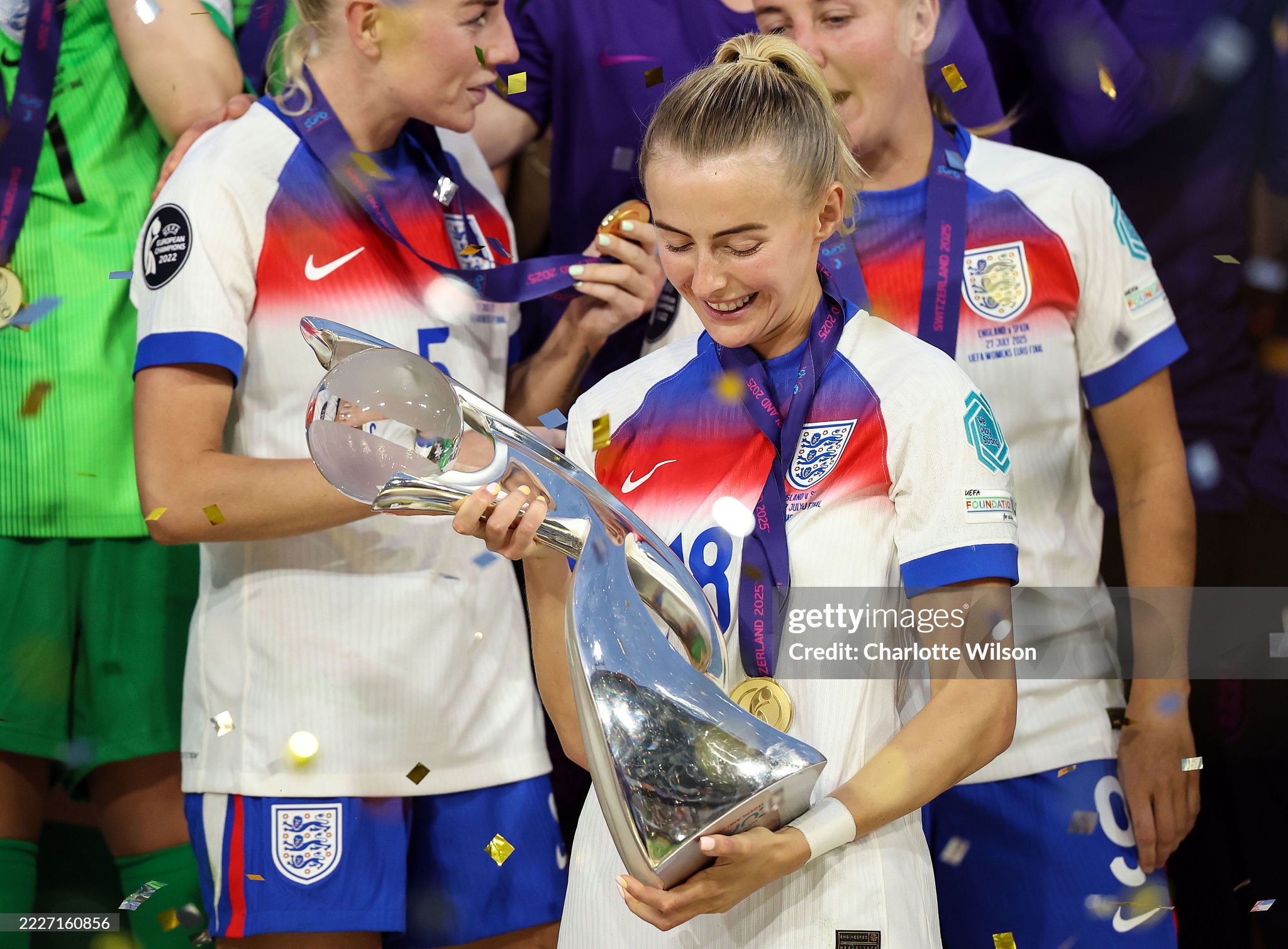
“That sums up her tournament, to be honest” Karen Bardsley observed for Radio 5 Live, as Salma’s spot kick span wide of the upright, opening the door for Chloe Kelly to hammer the ball past Coll and retain the Euros for England.
Carter conquers the doubters
As much as Spain’s blunt attack should be picked apart, acknowledgment should also be offered to one of the surprise star performers on the night, Jess Carter. The withdrawal of Millie Bright on the eve of the Euros had left Wiegman struggling to find the right partner for Leah Williamson at centre back. Alex Greenwood, Esme Morgan and Jess Carter were all given auditions for the job, the question was who would receive the honour of playing in the final.
Even by Jess Carter’s own admittance, she had endured a poor tournament.
‘I don’t think my performances have been up to par to be honest’ she conceded after the final. Against France, Delphine Cascarino had ran her ragged at full back as France stormed into a 2-0 lead. A move to centre-back failed to see an improvement in performance. A calamitous first half against Sweden saw Carter cheaply concede possession in the build-up to Kosovare Asllani’s second minute opener, then found herself brutally torched for pace by Stina Blackstenius as Sweden doubled their advantage before the break. Despite this, Wiegman still opted to start her in the final, a decision that turned out to be a masterstroke.
Carter had the game of her life, and was equal to everything Spain could throw at her. The defensive lapses and errors that had dogged her throughout the tournament and in the UEFA Women’s Nations League were a distant memory. Once England had the equaliser, Carter was a resolute rock between the Spanish attack and her goal. This was Carter’s best performance in an England shirt since the 2023 World Cup final, also against Spain.
The tactical tweak by Wiegman to invert Lucy Bronze into midfield allowed England to shift into a back three, a formation that plays to Carter’s strengths and allows her to prosper. The roar at the end of extra time when she won a goal kick off Bonmatí was not just a celebration of a defensive success, but of a player who has rightly had questions asked of her performances. A player who has suffered retrograde hate and disgusting racist abuse by online trolls, and has responded to them all in the most heroic and glorious of fashion.
Wiegman’s Lauren James injury gamble was a bust
Whilst the decision to start Jess Carter proved to be a masterstroke, the decision to start Lauren James proved to be a misfire. The temptation to gamble on James’ fitness ahead of the Euros final was too alluring for Wiegman to resist. There is no doubting that when fully fit, James is the most talented winger in England’s arsenal. However having suffered a hamstring injury against Belgium in the Nations League, James had missed the remainder of Chelsea’s treble-winning season. Her sole minutes before the tournament came in a 30-minute cameo in the Lionesses’ send-off match against Jamaica.
It is a tale as old as time with England, as half-fit extremely talented players are rushed back to make the squad. That is in the hope that they will be at their best when the showpiece event begins, only for them to not play or struggle for form when they do. Nevertheless, against the Dutch, it appeared as through the gamble had paid off, as James gave an electrifying display with two goals in a 4-0 demolition of the 2017 champions.
But as the tournament progressed, the risk on her match fitness began to outweigh the reward. James played 120 minutes against Sweden, but her sole contribution was to see her penalty saved in the shootout. Having limped off against Italy at half time, Wiegman, rather than start Beth Mead or Chloe Kelly in her place, went double or nothing in the final and started the Chelsea winger again.
The decision backfired, as James didn’t even make it to half time. Even within the opening minutes, it was clear this was an error of judgement. A spilled Alessia Russo shot saw the ball land at her feet in front of goal. Undoubtedly a fully fit James tucks home the rebound, as she did against the Netherlands. Instead, the ball rolled harmlessly between her feet. The only saving grace was that her withdrawal saw Chloe Kelly enter the fray in her place, a change that tipped the match in England’s favour.
Lauren James was not the sole half-fit player Wiegman put her chips all in on. Lauren Hemp, Georgia Stanway and Alex Greenwood all suffered heavily disrupted seasons due to injury, but Wiegman expressed a preference for them over any other alternatives. The Dutch head coach banked on their established talent and previous tournament experience over the potential of the unknown. All three underwhelmed for large parts of the Euros, yet started every match, contributing to sluggish starts that repeatedly required the finishers off the bench to rectify. Wiegman will point to the European trophy lifted on that parade up the Mall to argue that the end justified the means. However this very much felt like a mis-step England got away with, and to repeat this in Brazil in two years’ time will not produce the same outcome.
That being said, the great exception was Lucy Bronze. After the game, Bronze, who had once again enjoyed a stellar tournament, had played its entirety with a fractured tibia. But then again, Lucy Bronze has always been exceptional and tough is her middle name.
Bonmatí return unbalanced overstuffed midfield
Wiegman was not only manager in the dugout to gamble on an unfit player at the Euros. Spain possesses an abundance of talent in the midfield, too many to be played at the same time. As Norway found out to their own demise, simply cramming every star player into the team at once, regardless of their ideal position, is not a winning formula. However, when Aitana Bonmatí suffered a bout of viral meningitis in their tournament build up, Spain found themselves with a bizarre luxury of reduced options, giving them a clarity of team selection.
With Bonmatí only fit enough for the bench in the opening game, Montse Tomé selected 19-year-old Vicky Lopez to start alongside Patri Guijaaro and Alexia Putellas. The results were impressive, a 5-0 demolition of Portugal and a 6-2 battering of Belgium. Whilst naturally, there is the caveat in the nature of the opposition, the football Spain played was electric. Fast paced, quick movement, intricate and devastating. It was at a technical level not seen at the Euros until that point.
Spain had found a potent winning formula that looked certain to carry them all the way to the final, but the re-introduction of Bonmatí in place of Lopez noticeably unbalanced the team. A clear deteriorating trend of results followed, as La Roja failed to sustain their level. In the group stage Spain scored 14 goals over three games. In the knockout rounds, they scored only four. Spain still dominated possession, they still controlled matches, but they never found the same cutting edge nor clear-cut chances that came to them so easily at the start of the tournament.
It should be stressed that Bonmatí herself was not responsible for Spain’s demise, quite the opposite in fact. Her back heel assist against Switzerland and her late wonder strike against Germany were what got Spain to their first European Final and won her Player of the Tournament. Bonmatí’s genius was what got Spain to the Final, but it came at the expense of the collective. Montse Tomé could have either stuck with Bonmatí as a ‘finisher’ from the bench or sought a means to integrate her properly back into the side, potentially at the expense of one of her other star midfielders. Instead, she did neither, and Spain’s unrelenting goalscoring machine slowly coughed and spluttered, until it struggled to find a winner in the final against a resolute English defence.
After Alessia Russo’s equaliser, Spain had 12 shots on goal to England’s one, with all but two with an xG of 0.1 or less. There would be no individual magic to save Spain this time either. Bonmatí played the 120 minutes, but only had four efforts on goal, none of which came close to stretching Hampton in goal (her best effort had only an xG of 0.05). Ultimately, her overriding impact on the game was seeing her penalty in the shootout saved, as the momentum swung England’s way.
Finishers flourish once again
Tomé’s desire to start with all her aces contrasted with Wiegman’s preference to hold a few up her sleeve. That is what proved to be the difference in the game. The removal of Putellas and Gonzalez, combined with the introduction of Paralluelo, weakened Spain, whereas Chloe Kelly unquestionable re-invigorated England, as she had done throughout the tournament. Chloe Kelly and Michelle Agyemang have become England’s star ‘finishers’, a trademark of Wiegman’s tournament methodology.
Whilst in 2022 they were utilised to edge out a game teetering on the margins, here they held greater importance, deployed in full blown rescue acts in knockout matches that looked well beyond saving. On any other plane of existence, Sweden or Italy should have knocked England out, yet it was the finishers’ late heroics that made the impossible possible.
They may have been sent forward earlier than normal here, but the impact ramained the same. Kelly’s delivery was undefendable, and Russo’s superb, guided header left Coll with no chance. With their defence settled, England were able to manage the game out until the penalty shootout. In the crunch moments, the two attacking substitutes made the decisive impact: Paralluelo missed, whilst Kelly, once again, delivered the coup de grâce for England.