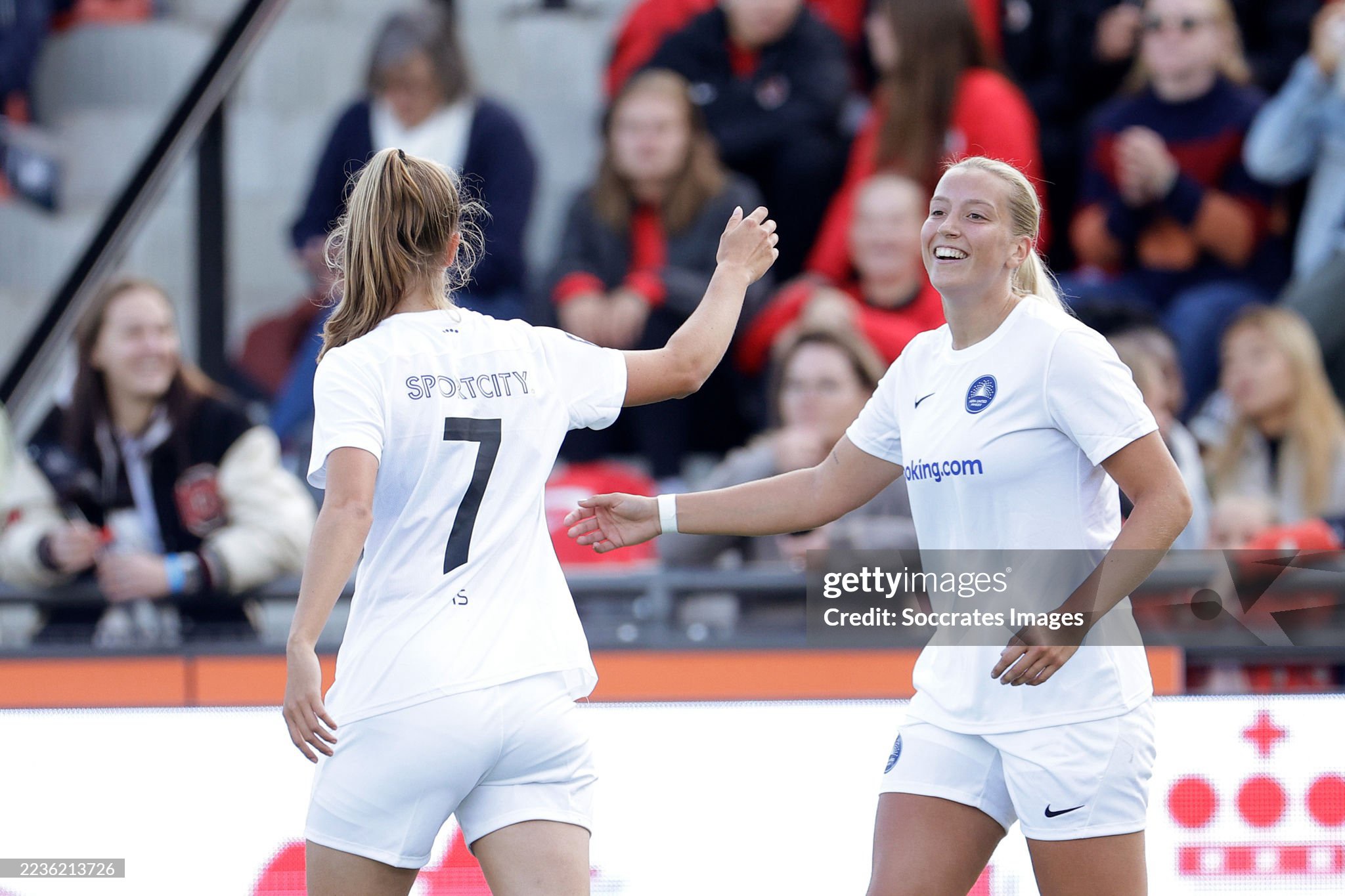
The Netherlands’ topflight — the Vrouwen Eredivisie — is now home to its first independent women’s football club, HERA United.
On September 7, Dutch club AZ’s training ground was home to a historic match as they welcomed the Amsterdam trailblazers.
The Halfway Line digs into the short history of the club to provide you with a guide to the Eredivisie’s latest addition, including data on their playing style by Marc Lamberts.
Hera, the queen of the Olympians
Back in 2023, Ajax Women won the Vrouwen Eredivisie title, but weren’t allowed a trophy lift by the club because of the disappointing season the men’s side had. Marieke Visser saw it as proof of deeply rooted inequality in Dutch football and, together with her co-founders, established a club entirely focused on the ambitions of women. They named it after Greek goddess Hera, the queen of the Olympians.
And they are not just here to play football, they want to compete too. Visser has said that they want to win the Champions League in 10 years time and are hoping for international players to join them.
The road to playing professionally in the Eredivisie
HERA United’s entry into the Eredivisie was made possible through a collaboration with Telstar, which had been operating a women’s team but faced increasing financial and organizational challenges due to the football association’s striction of the licensing criteria. As part of the agreement, HERA United took over Telstar’s license for top-level women’s football, allowing the new club to compete in the Vrouwen Eredivisie. While HERA now manages the first team independently, the youth academy remains a shared effort between HERA United and Telstar.
Before HERA United could join the Eredivisie as an independent club, it had to overcome several structural and regulatory barriers. The KNVB (Dutch FA) required women’s teams to be part of existing men’s clubs, effectively preventing the formation of standalone organizations. HERA United challenged this model, arguing that it conflicted with principles of equal treatment. After extensive discussions by HERA with the KNVB, the football association amended its rules, making it possible for a women-only club to compete in the Vrouwen Eredivisie.
The people behind HERA
We have already mentioned Marieke Visser. She has a background in PR and communications and played a lot of football in her younger years. HERA United allows her to combine that passion for football with her business experience. Visser doesn’t do all the work alone. Susan van Geenen is the general director of HERA and has an extensive background in sports, media and communications. She used to work for Nike, Feyenoord and Disney, among others. Barbara Barend is the third founder and owner of the club. Barend is known to the general Dutch public as a sports journalist and presenter.
Vera Pauw has also played a role for HERA United. Pauw used to coach the Ireland Women’s national team, the Dutch Women’s national team and NWSL side Houston Dash, among others. Her time with these teams has not gone by without any controversies. Pauw acted as a technical advisor for the new Dutch women’s club, responsible for the sporting and strategic directions. She no longer works for the club, as she has recently taken on the job of the United Arab Emirates’ women’s national team head coach.
A wholly independent women’s team
It makes sense that people think of London City Lionesses (LCL) when reading about this women only football club. It is one of the very few parallels between the two clubs though. The other parallel being both owners are very ambitious. But LCL is owned by Michelle Kang, who owns multiple football clubs. HERA’s owners only own HERA. The Women’s Super League (WSL) is one of the best leagues in the world, whereas the Eredivisie is of a much lower level. Visser, Barend and van Geenen did meet with Kang to share experiences.
Investment and ambitions at HERA
Amsterdam hosted the Olympic games in 1928. It wasn’t just any Olympic games, it was the first edition where women were allowed to compete too. The Amsterdam Olympic stadium is a testament to that iconic edition and still stands in the south of the City and is still in use. HERA plan to use the stadium for its bigger and more important games. They play their other games at Sportpark Goed Genoeg, which translates to Sportpark Good Enough.
As Visser said, the club want to win the Women’s Champions League in 10 years. For that, they would need more investment. van Geenen has said. The ambitions for this season are a bit lower. Captain Puck Donker told Dutch newspaper NRC that HERA have to be careful they don’t relegate after this season. “It sounds dark, but if you look at where we have come from and where we want to go, that is a must for now”, she said. After three matches, the team has one point, from their 2-2 draw against AZ on the opening day. We’ll go into their playing style and data below.
How are HERA fairing in the Eredivisie?
Let’s have a look at the numbers. First of all we can have a look at playing style tendencies. In this percentile pizzaplot, we can see the tactical tendencies based on data:

They score very high on Goalkeeper build-up, Long balls, Low block and verticality. This indicates that they give the ball to their central defenders and play it long and direct from there on. They don’t have a effective pressing strategy as seen by their high PPDA (passes allowed per defensive action) and low High Press number. It seems that they are not very good on ball retention.
But we can investigate that further by looking at what they do with their passing sequences.

What we see in this scatterplot is the tactical profile of their passing style of play. They score extremely high on the meters per second metric, meaning that the ball is likely to have made a lot of progresss on the field. Together with their low number of passes per sequence, we can detect that they play a direct style of play with emphasis on playing on the counter.
Football is based on scoring as many goals as possible and conceding as few as possible. How does that look like in chance creation? Let’s have a look where HERA United rank compared to the rest of the league.

It’s probably quite clear, but HERA United has created the lowest total xG in the Eredivisie so far. Together with Excelsior Rotterdam and NAC Breda they create the lowest quality chances.

In terms of xGA or expected goals against, they score the highest. They concede the most total xGA of everyone with a number of 5,27 XGA. After HERA United, NAC Breda and Excelsior Rotterdam follow.
It’s just three games into the season, but their numbers have to improve if they want to avoid the drop at the end of the Eredivisie 2025-2026 season.