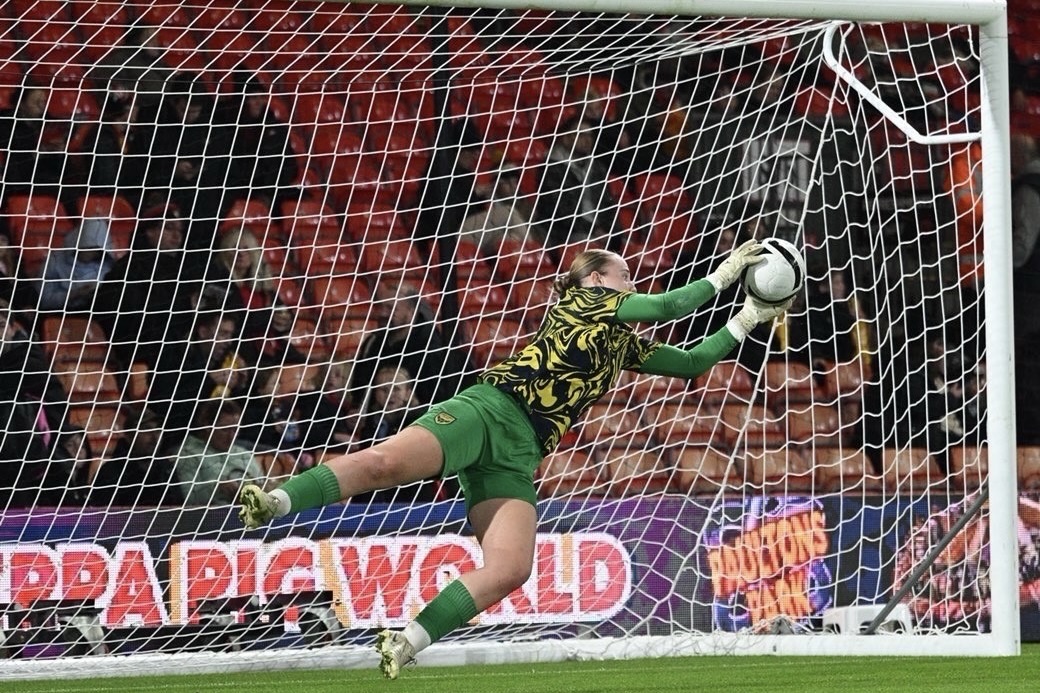
Former Arsenal goalkeeper Maddison Millington-Stanbury opens up about her autism diagnosis in this exclusive interview.
Millington-Stanbury joined Oxford United last summer from the Arsenal Academy, which is where she was playing when she received her diagnosis. She decided not to tell her teammates about it, wanting to get more comfortable with the diagnosis herself first, but she did tell some of the coaching staff.
Now, she speaks to The Halfway Line about dealing with challenges and advocating for her needs.
It wasn’t until Millington-Stanbury arrived in Oxford that she decided to tell fellow players as well. “I was still trying to understand myself. I first got the diagnosis, and some family members said to me that I didn’t look autistic, or I didn’t seem autistic,” she says.
“So for me, I kind of took that and held that to myself for quite a while when I was worried that I was going to get judged by my teammates if I said something. So, I kept it to myself until I understood myself as a person with the autistic diagnosis.
“Once I knew who I was and what I wanted of other people that could help me, that’s when I obviously became more open about it.”
Oxford United ‘really supportive’ praises Millington-Stanbury
The staff and players at Oxford United have been accommodating towards Millington-Stanbury’s needs. Player care lead Shelly Provan, who also plays for the club, sent her a message in preseason asking for a list of what Millington-Stanbury needs help with or doesn’t feel comfortable with. Millington-Stanbury tells us one of the things on her list was public speaking.
“In our analysis sessions, each week, a new person would have to speak openly. And for me, like, for the first few months, I was very shy, I didn’t want to do it, and I was very nervous.
“But as the season’s gone on, the players have become more understanding of me. They’re very much encouraging. So they’re kind of like, look, you can give it a go. There’s no harm in trying. And they’re really supportive with it,” the goalkeeper explains.
She continues: “So for me, yesterday or the day before, I was standing at the top front of the analysis room with a tactics board and I didn’t think I’d ever be able to do that. But that’s because of the staff and the players that have helped me and understand me as a player and as a person.”
Speaking to Millington-Stanbury, one gets the impression that she is wise beyond her age and ready to deal with anything that comes her way. A good example of that is when we ask her how she deals with pressure. She says that everything happens for a reason, and lives very much in the here and now.
She takes to her game day routines to help her deal with pressure before a big match: she eats poached eggs on toast with salmon for breakfast, and listens to music. At the stadium, she puts her left football boot on first, and as soon as the boots are on, the gloves follow. The left glove goes on first.
“Even though I’m right-handed, it’s always the left,” she illustrates.
‘Being brave’ in new situations
Another testament to her mental resilience is the way she deals with new situations. Millington-Stanbury is ready to take on any challenge that comes her way, however daunting it may seem at first. Meeting new teammates when moving clubs, for instance, can be scary for her.
“At the start of the season, meeting new people, that was so scary because I didn’t know a single person, I didn’t know anybody there. So it was very much meeting new people, having to be brave, having to be open and speak to people,” the 20-year-old recalls.
“And you know, because normally I’d shy away from it, now it’s different. Obviously, I know all the players, but if I, you know, later on down the line, if I go to a new club, I’m going to have to do that same process again. But it’s more just being brave, being open about it and not shying away from speaking to new people,” she says.
‘I want to be the best version of myself’
Millington-Stanbury does not see her autism as standing in the way of becoming successful. Her autism gives her the ability to focus on her play and her footballing career. Millington-Stanbury calls it her ‘tunnel vision’. She also feels that her ability to ask a lot of questions helps her become a better player.
“I think for me, I want to be the best version of myself. So if I’m not doing well, I will ask questions, and I will be like, ‘Right, how do I do things differently?’” Millington-Stanbury details.
“I’ve been told before by previous goalkeeper coaches that I’m very easy to coach because I ask questions and I listen. Another thing for me is I’m not going to shy away from criticism, but for me, in that way, it has to be criticism that I’m going to understand.
“Not ‘oh, you need to do better’, but it’s more like ‘you need to be better’. But why do I need to be better? It’s always the whys and the hows. That’s always what it’s been like with me,” she reflects.
Advice for clubs, governing bodies and neurodivergent players
There is a growing understanding of people’s individual needs in wider society as well as in football, which means there is a focus on neurodiversity as well. Asked what advice Millington-Stanbury would give to clubs and governing bodies, she urges them to listen to players who are neurodivergent and to focus on how they can help accommodate their needs.
“And also,” she adds, “we’re not any different. As much as there’s different things that we may need more support in – or things like that – we’re no different to someone who hasn’t got a neurodivergent condition.”
What advice would Millington-Stanbury give other neurodivergent players? She encourages them not to let their neurodivergence be something that stops them.
“Keep going, be open, be honest with your coaches, be open with your teammates, because at the end of the day, they will all help in some way or another.”
Feature Image credit: Oxford United.